Move from guesswork and detection, to cryptographic proof
InReality provides the ability to distinguish real from fake content.
Generative AI is getting better and better by the day, and detection can't keep up
Luckily, our devices hold the answer to authentic content.


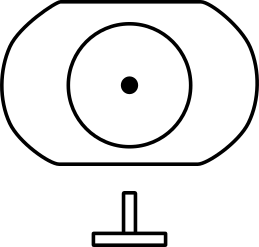

When we capture content like photos, videos and audio, our devices create high quality data. This metadata states key information such as when the content was captured, where it was captured and what device captured it.
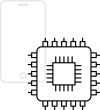
The newest devices by Google and Sony all have even higher levels of data quality. This high quality data derives from the camera chip that sits within our devices. The data is extremely secure, and AI cannot replicate it.
However once is leaves the device, proving this data is un-manipulated and real becomes more difficult. It is possible to change this data, or strip it from the content altogether.
That's where InReality comes in. By signing the high quality data with a cryptographic hash, we are able to secure it. We then allow other to independently verify this information. Proving its authenticity.

TECH FOCus
At InReality we sign real content so anyone can verify its authencity
Tech explained
Cryptographic signing, without the blockchain baggage

Today’s web cryptographic security typically uses blockchains. While blockchains provide strong security guarantees, they also come with significant drawbacks, they are often slow, costly, difficult to scale, and incompatible with modern data rights (right to be forgotten).
We are not a blockchain
Our system delivers the same level of cryptographic security through a completely new architecture, one built from the ground up to overcome the limitations of blockchains. Our technology achieves the same security guarantees with greater speed, scalability, efficiency, and respect for data rights.
Cryptography is the foundation of digital security, it protects everything from secure websites to online banking, working silently in the background. InReality applies the same proven cryptographic principles to safeguard real-world content.
Tech explained
How we utilise the standards to sign real content
The Coalition for Content Provenance and Authenticity provides an objective standard for what data fields are captured about a piece of content and how it is structured.
Microsoft, Sony, Adobe, Open AI and Google and others are members of the standard. Connecting up the hardware and software providers involved in content creation and publishing. C2PA provides a "nutrition label" from the creator of the digital content, noting how the content was made, whether a real photo, a deepfake, animation or digital art.
.svg)

The Creator Assertions Working Group, or CAWG, adds onto what C2PA is doing. Whilst C2PA provides secure ways of stating how content was made, CAWG attaches information about who made it.
InReality uses the C2PA and CAWG standards to sign content, while adding specialized security for guaranteeing real content. Our security provides proof that original content was truly captured by a device, that editing did not remove authenticity and make it verifiable by everyone. Think of it as C2PA and CAWG, but with a security layer.
