%20--%3e%3csvg%20width='10.365639mm'%20height='15.192757mm'%20viewBox='0%200%2010.365638%2015.192757'%20version='1.1'%20id='svg79707'%20inkscape:version='1.4.3%20(1:1.4.3+202512261035+0d15f75042)'%20sodipodi:docname='inreality.svg'%20inkscape:export-filename='student_job_posting_2.pdf'%20inkscape:export-xdpi='96'%20inkscape:export-ydpi='96'%20inkscape:export-batch-path='export'%20inkscape:export-batch-name=''%20xml:space='preserve'%20xmlns:inkscape='http://www.inkscape.org/namespaces/inkscape'%20xmlns:sodipodi='http://sodipodi.sourceforge.net/DTD/sodipodi-0.dtd'%20xmlns:xlink='http://www.w3.org/1999/xlink'%20xmlns='http://www.w3.org/2000/svg'%20xmlns:svg='http://www.w3.org/2000/svg'%3e%3csodipodi:namedview%20id='namedview79709'%20pagecolor='%23ffffff'%20bordercolor='%23666666'%20borderopacity='1.0'%20inkscape:showpageshadow='2'%20inkscape:pageopacity='0.0'%20inkscape:pagecheckerboard='0'%20inkscape:deskcolor='%23d1d1d1'%20inkscape:document-units='mm'%20showgrid='false'%20inkscape:zoom='1.4142136'%20inkscape:cx='4343.7569'%20inkscape:cy='29.344931'%20inkscape:window-width='1920'%20inkscape:window-height='1011'%20inkscape:window-x='0'%20inkscape:window-y='0'%20inkscape:window-maximized='1'%20inkscape:current-layer='layer1'%20showguides='false'%3e%3cinkscape:page%20x='2.6540307e-05'%20y='-7.1358691e-08'%20width='10.365639'%20height='15.192757'%20id='page19'%20margin='0'%20bleed='0'%20inkscape:label='logo'%20/%3e%3c/sodipodi:namedview%3e%3cdefs%20id='defs79704'%3e%3clinearGradient%20id='linearGradient50'%20inkscape:collect='always'%3e%3cstop%20style='stop-color:%23f97316;stop-opacity:1;'%20offset='0.1701287'%20id='stop50'%20/%3e%3cstop%20style='stop-color:%237c3aed;stop-opacity:1;'%20offset='0.60597193'%20id='stop51'%20/%3e%3c/linearGradient%3e%3cradialGradient%20inkscape:collect='always'%20xlink:href='%23linearGradient50'%20id='radialGradient51-6'%20cx='2489.9111'%20cy='159.33452'%20fx='2489.9111'%20fy='159.33452'%20r='5.0509744'%20gradientTransform='matrix(7.6652778e-4,3.0665387,-3.0681044,7.6677597e-4,2963.71,-7477.2732)'%20gradientUnits='userSpaceOnUse'%20/%3e%3c/defs%3e%3cg%20inkscape:label='Layer%201'%20inkscape:groupmode='layer'%20id='layer1'%20transform='translate(-2475.2363,-156.73378)'%3e%3cpath%20id='circle47-7-2'%20style='fill:url(%23radialGradient51-6);stroke:none;stroke-width:2.26177;stroke-linecap:round;stroke-linejoin:round;stroke-dasharray:none'%20d='m%202476.7676,156.85438%20a%201.3994706,1.3994706%200%200%200%20-1.3994,1.3994%201.3994706,1.3994706%200%200%200%201.3994,1.39939%201.3994706,1.3994706%200%200%200%201.3994,-1.39939%201.3994706,1.3994706%200%200%200%20-1.3994,-1.3994%20z%20m%203.8804,5.1e-4%20a%201.240895,1.240895%200%200%200%20-1.2403,1.24024%201.240895,1.240895%200%200%200%201.2403,1.24023%20c%201.7555,0%202.2551,0.95189%202.2613,1.90221%200.01,0.95032%20-0.4555,1.88516%20-2.2613,1.88516%20a%201.2410191,1.2410191%200%200%200%20-1.0744,1.86087%20l%203.5802,6.20117%20a%201.240895,1.240895%200%200%200%201.6949,0.45527%201.240895,1.240895%200%200%200%200.4553,-1.6955%20l%20-2.7207,-4.7129%20c%201.7641,-0.71447%202.8193,-2.3649%202.8086,-4.01164%20-0.014,-2.18341%20-1.8688,-4.36511%20-4.7439,-4.36511%20z%20m%20-3.8804,4.038%20c%20-0.7753,0%20-1.3994,0.62408%20-1.3994,1.3994%20v%208.11372%20c%200,0.77532%200.6241,1.39991%201.3994,1.39991%200.7753,0%201.3994,-0.62459%201.3994,-1.39991%20v%20-8.11372%20c%200,-0.77532%20-0.6241,-1.3994%20-1.3994,-1.3994%20z'%20/%3e%3c/g%3e%3c/svg%3e)
Summary
CEPIC is the voice of the visual content industry, and collects individuals from agencies, rights-holders, content creators and more, to foster collaboration and knowledge sharing. CEPIC 2026 was held in Valencia with a three-day programme packed with talks, mingling, panels and discussions.
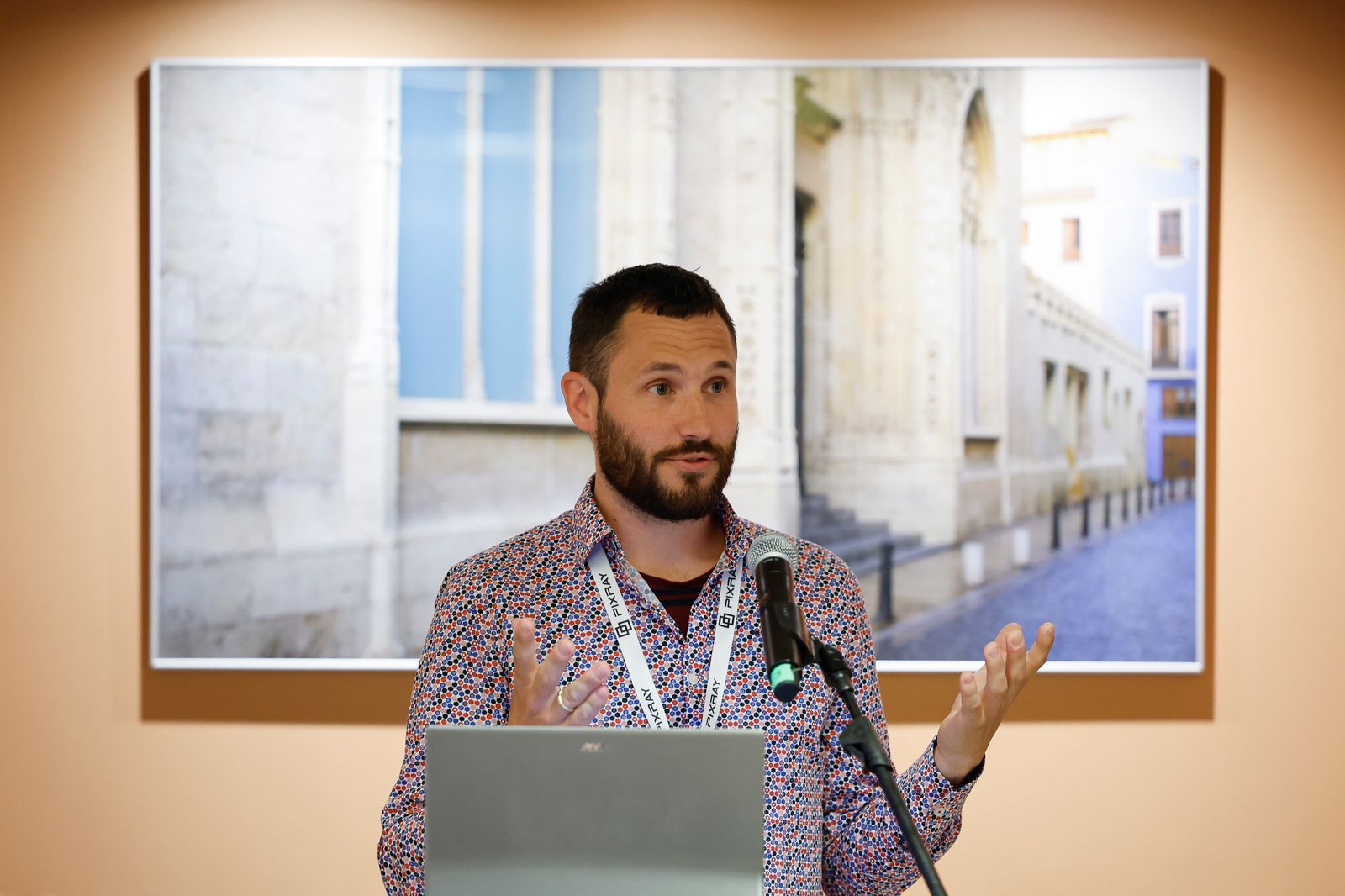
Our CEO, Jeppe, attended CEPIC 2026 last week and gave the final keynote of the conference; Protecting Real Content Online, to offer an innovative approach to handling the rise of generative AI and its effects on the industry.
Since not everyone got to be there, we're bringing the talk to you! We have recorded a condensed version of the talk, which you can see above. You can also find the transcript below!
Transcript
Hello everyone, I'm Jeppe and this is a condensed version of my keynote from CEPIC this year. I'm going to start us off with a short video first.
This is one of the few commercials that I remember twenty years later, and it's by Sony, a piece called heartbeats, where they did actually drop a two hundred and fifty thousand rubber balls down a street of San Francisco. And of course, what I wanted to highlight with this video is the doubt problem that we have today. If anyone made this work today, we would probably all doubt whether it was real or whether it was simply AI. And this brings us to the title of the talk Protecting Real Content Online, making real content, provably real and provably yours.
Now we have a lot of examples of visual content where fakes have participated in next to real. So Boris here won the Sony World Photography Award in two thousand and twenty three for this photo, which isn't a real photo. As far as I understand he actually noted this in his submission, and I think maybe even pulled out of the competition because he did it to prove that it could be done. This is an interesting work. The Book of Veils, which as far as I understand, is a misinformation book on misinformation. So it is about misinformation, but it itself is also misinformation. So every photo in the book is fake. We have a famous lawsuit between Getty Images and Stability AI, where Getty Images claims a Stability AI trained on their data without being allowed to. And as far as I understand, in the UK version, Stability AI largely got away with it. So they were allowed to train on this content to train the competition for Getty Images themselves. And this is a fairly recent example, a more newsworthy example, with a fake photo of a so-called F-15 rescue in Iran shared by governors and TV professionals, which isn't a real photograph.
So basically, generative AI can be used maliciously. AI's can fake anything, and it's difficult for humans to tell the difference between real and fake. In the example here, I think it's from insurance, where we can have the discussion of whether a car crash did or did not in fact, take place. So visual content has the issue that if it's real, it has difficulty with standing out. It's going to be mixed with all the fakes in a sea of sameness created by generative AI. We have a lack of trust, which of course is super important for the news companies. Anyone can claim anything with evidence, and that fake evidence is becoming very, very real looking and everything is copied and trained on my social media data or your professional data, all trained for the competition. So we need a way to handle the rise of generative AI in the space of visual content.
Now, the first approach that we often use is detection. We ask, can we just detect the AI content and then either remove it or warn about it? But deepfake detection is a little bit like asking your friend, is this real? But that friend has to keep up with the fastest growing and best invested technology, perhaps in history, which is very, very difficult to do, because it's retrospective. You receive data in, and then you try to handle it as good as you can. It's always a step behind. Any time these big generative AI players update their weights or new research comes out in AI. The detection companies will struggle to keep up. It's also low budget, so it's not a problem for a criminal to spend twenty dollars on a deepfake. But we can't spend twenty dollars on analysing every video we receive. So it's a really unbalanced game. And finally, we have the problem of undetectable AI, which we now discuss in research. What if we can create images or videos that have no flaws in them, no indication of AI? Well, in that in that case, detection is permanently game over and it doesn't matter what we do. So detection is pretty much out.
Another alternative is watermarking. And I didn't know that that many people at CEPIC knew quite a bit about watermarking. So there's largely two types of watermarking in this space. It's ownership and AI outputs. Ownership watermarking is a little bit like labelling your luggage. It's really, really good for finding your luggage, and that's important to find your luggage. It's important to find your visual content if you own it, it's really important to find it, but it doesn't really help in our space. It also has the issue that if I show you the watermark, um, then it becomes very easy to remove that watermark, which means that if I prove something is real, it becomes easy to remove the same indicator that showed that it was real. So it protects discovery, not really authenticity. So it's very useful tool, but it doesn't really help for, for the problem that I'm interested in. Then we have AI output watermarks very much pushed by the EU and the EU AI act. Synth ID here is Google's AI output watermark. But this has a different problem. If I ask the question is this real? Then I have to ask every single deepfake vendor on the planet did you make this? I have to go to Google and say, did you make this? I have to go to OpenAI and said, did you make this? I have to ask everyone. And then only by asking everyone and they all say no can I then have an opinion about authenticity. But of course, first of all, criminals will not mark their content. There is a company in Cambodia that trains AI models for fraud. They are not going to be labelling their content. And of course, the absence of a watermark doesn't really prove anything. If I do ask everyone if they made it and they all say no, what does that really leave me with? Is it then real? And then finally, there's the discussion of whether it actually works. So Synth ID was reverse engineered in, in twenty twenty six, it can be removed. It's not easy, but we generally believe that it will be possible to remove watermarks. So watermark is out.
Now, I realise that I criticise AI a lot, and I want to say that AI is actually really, really amazing. I use it for a bunch of purposes myself. I used it to make this presentation. And the illustration here doesn't matter that it's not real. It's really useful for the tool that I’m, for the visual tool that it is. But AI just doesn't help with the problem that I'm fascinated about, the problem of authenticity. And I know this because I worked on that problem in research for quite a few years. For six years, I worked on AI for misinformation detection, try to use AI to detect these problems, and it never really worked. And now we believe it's probably never going to work. So we need to do something else.
What we wish to do is to flip the problem around. We need to stop focusing on what's fake and start focusing on what's real. We don't want to do detection. We don't want to, you know, run through piles of content to understand what's fake and what's real. We want to protect the real and keep it that way.
Basically, what we're going to create is a little technological bubble of the internet, and everything within that bubble is provably real and cannot be manipulated. AI basically doesn't have a way to enter this bubble. It doesn't have the access card. It can't be inside the bubble. Anything outside the bubble is the same as the internet today. Maybe real, maybe not. Who really knows? We do this with a method that we in short call check, sign and verify. Check means that we evaluate content as close to the source as possible and check for authenticity. A lot of new hardware have a lot of new tricks. Some of them are applied automatically. Some need to be applied by a company like ours or others. But there's a lot of new things we can do to basically secure authenticity as close as possible to the source. We sign it cryptographically. This is the security layer on top. There is a standard, C2PA, which we use for this. And finally we allow anyone to verify it. And the verify step is sometimes underrated. Of course, without verification, the two other steps become irrelevant. And furthermore, we wish for everyone to be able to verify authenticity. Anyone who receives a real image should know that it's real.
We integrate into the existing workflows of companies, whether it's media holders or if it's photography organisations, we wish to integrate into those processes and make sure that whatever they get in is real, and whatever they display to customers or to the public is also real. C2PA, as I mentioned, is a great standard that we build upon. We use it to encode our security and basically extend it for authenticity purposes.
So in terms of the three problems I was, I was talking about. So first of all, it's difficult to stand out today. Well, with this type of technology, we can make real content stand out because real content should never be put next to fake content. It should have its own life. This is the bubble. We should be able to display real content and be proud of it, and have no confusion about whether it's real or not. Furthermore, we create provably real content that we can guarantee is authentic to really strengthen the trust in us and to the digital products we deliver. And then there's the concept of copying and I want to bring us back to this bubble for a second, because this bubble have different properties that are quite interesting. So one thing is, let's say that you have created a provably real photo that lives inside this bubble, and I wish to steal it. Well, I have basically two ways to do this. I can steal it and try to stay inside the bubble. But that gives me a problem because in order to keep it provably real, I also have to prove that I stole it. So if I want to stay within this space of real content, I literally have to wave a flag saying that I stole this content. I can also steal it and decommission it from reality, pull it out of the bubble, join the sort of garbage side of the internet where I can steal content, but I also devalue the work. So if I steal your content, I can't participate next to your content because the most valuable version, the real version is provably yours, and if I try to compete with it, I have to announce that I stole it. This is why we say we want to make content provably real and provably yours.
Now we embed into existing workflows, which has a lot of different, um, finesse. So we want to help with capture all the way, potentially all the way at device level, check and sign that this is real. We help with cataloguing for your customers or for yourself, helping to organise and analyse what is really the authentic content we have. Production, it’s fine to, of course, do editing before something hits a front page of a newspaper. So how do we do authentic productions? That is what we hope to do. And finally publishing. Of course, everyone should be able to receive this and verify its authenticity. So that is what we want to do.
We want to help real content stand out and make it provably real, and provably yours. Thank you.
The presentation includes a short excerpt from Sony’s BRAVIA “Balls / Heartbeats” advertisement for purposes of commentary and illustration within an educational conference talk.
The original advertisement and associated music are the property of their respective copyright holders, including Sony and related rights owners.
This use is transformative and limited in scope, and is included here under applicable fair use / quotation / fair dealing principles.