%20--%3e%3csvg%20width='10.365639mm'%20height='15.192757mm'%20viewBox='0%200%2010.365638%2015.192757'%20version='1.1'%20id='svg79707'%20inkscape:version='1.4.3%20(1:1.4.3+202512261035+0d15f75042)'%20sodipodi:docname='inreality.svg'%20inkscape:export-filename='student_job_posting_2.pdf'%20inkscape:export-xdpi='96'%20inkscape:export-ydpi='96'%20inkscape:export-batch-path='export'%20inkscape:export-batch-name=''%20xml:space='preserve'%20xmlns:inkscape='http://www.inkscape.org/namespaces/inkscape'%20xmlns:sodipodi='http://sodipodi.sourceforge.net/DTD/sodipodi-0.dtd'%20xmlns:xlink='http://www.w3.org/1999/xlink'%20xmlns='http://www.w3.org/2000/svg'%20xmlns:svg='http://www.w3.org/2000/svg'%3e%3csodipodi:namedview%20id='namedview79709'%20pagecolor='%23ffffff'%20bordercolor='%23666666'%20borderopacity='1.0'%20inkscape:showpageshadow='2'%20inkscape:pageopacity='0.0'%20inkscape:pagecheckerboard='0'%20inkscape:deskcolor='%23d1d1d1'%20inkscape:document-units='mm'%20showgrid='false'%20inkscape:zoom='1.4142136'%20inkscape:cx='4343.7569'%20inkscape:cy='29.344931'%20inkscape:window-width='1920'%20inkscape:window-height='1011'%20inkscape:window-x='0'%20inkscape:window-y='0'%20inkscape:window-maximized='1'%20inkscape:current-layer='layer1'%20showguides='false'%3e%3cinkscape:page%20x='2.6540307e-05'%20y='-7.1358691e-08'%20width='10.365639'%20height='15.192757'%20id='page19'%20margin='0'%20bleed='0'%20inkscape:label='logo'%20/%3e%3c/sodipodi:namedview%3e%3cdefs%20id='defs79704'%3e%3clinearGradient%20id='linearGradient50'%20inkscape:collect='always'%3e%3cstop%20style='stop-color:%23f97316;stop-opacity:1;'%20offset='0.1701287'%20id='stop50'%20/%3e%3cstop%20style='stop-color:%237c3aed;stop-opacity:1;'%20offset='0.60597193'%20id='stop51'%20/%3e%3c/linearGradient%3e%3cradialGradient%20inkscape:collect='always'%20xlink:href='%23linearGradient50'%20id='radialGradient51-6'%20cx='2489.9111'%20cy='159.33452'%20fx='2489.9111'%20fy='159.33452'%20r='5.0509744'%20gradientTransform='matrix(7.6652778e-4,3.0665387,-3.0681044,7.6677597e-4,2963.71,-7477.2732)'%20gradientUnits='userSpaceOnUse'%20/%3e%3c/defs%3e%3cg%20inkscape:label='Layer%201'%20inkscape:groupmode='layer'%20id='layer1'%20transform='translate(-2475.2363,-156.73378)'%3e%3cpath%20id='circle47-7-2'%20style='fill:url(%23radialGradient51-6);stroke:none;stroke-width:2.26177;stroke-linecap:round;stroke-linejoin:round;stroke-dasharray:none'%20d='m%202476.7676,156.85438%20a%201.3994706,1.3994706%200%200%200%20-1.3994,1.3994%201.3994706,1.3994706%200%200%200%201.3994,1.39939%201.3994706,1.3994706%200%200%200%201.3994,-1.39939%201.3994706,1.3994706%200%200%200%20-1.3994,-1.3994%20z%20m%203.8804,5.1e-4%20a%201.240895,1.240895%200%200%200%20-1.2403,1.24024%201.240895,1.240895%200%200%200%201.2403,1.24023%20c%201.7555,0%202.2551,0.95189%202.2613,1.90221%200.01,0.95032%20-0.4555,1.88516%20-2.2613,1.88516%20a%201.2410191,1.2410191%200%200%200%20-1.0744,1.86087%20l%203.5802,6.20117%20a%201.240895,1.240895%200%200%200%201.6949,0.45527%201.240895,1.240895%200%200%200%200.4553,-1.6955%20l%20-2.7207,-4.7129%20c%201.7641,-0.71447%202.8193,-2.3649%202.8086,-4.01164%20-0.014,-2.18341%20-1.8688,-4.36511%20-4.7439,-4.36511%20z%20m%20-3.8804,4.038%20c%20-0.7753,0%20-1.3994,0.62408%20-1.3994,1.3994%20v%208.11372%20c%200,0.77532%200.6241,1.39991%201.3994,1.39991%200.7753,0%201.3994,-0.62459%201.3994,-1.39991%20v%20-8.11372%20c%200,-0.77532%20-0.6241,-1.3994%20-1.3994,-1.3994%20z'%20/%3e%3c/g%3e%3c/svg%3e)
In a nutshell
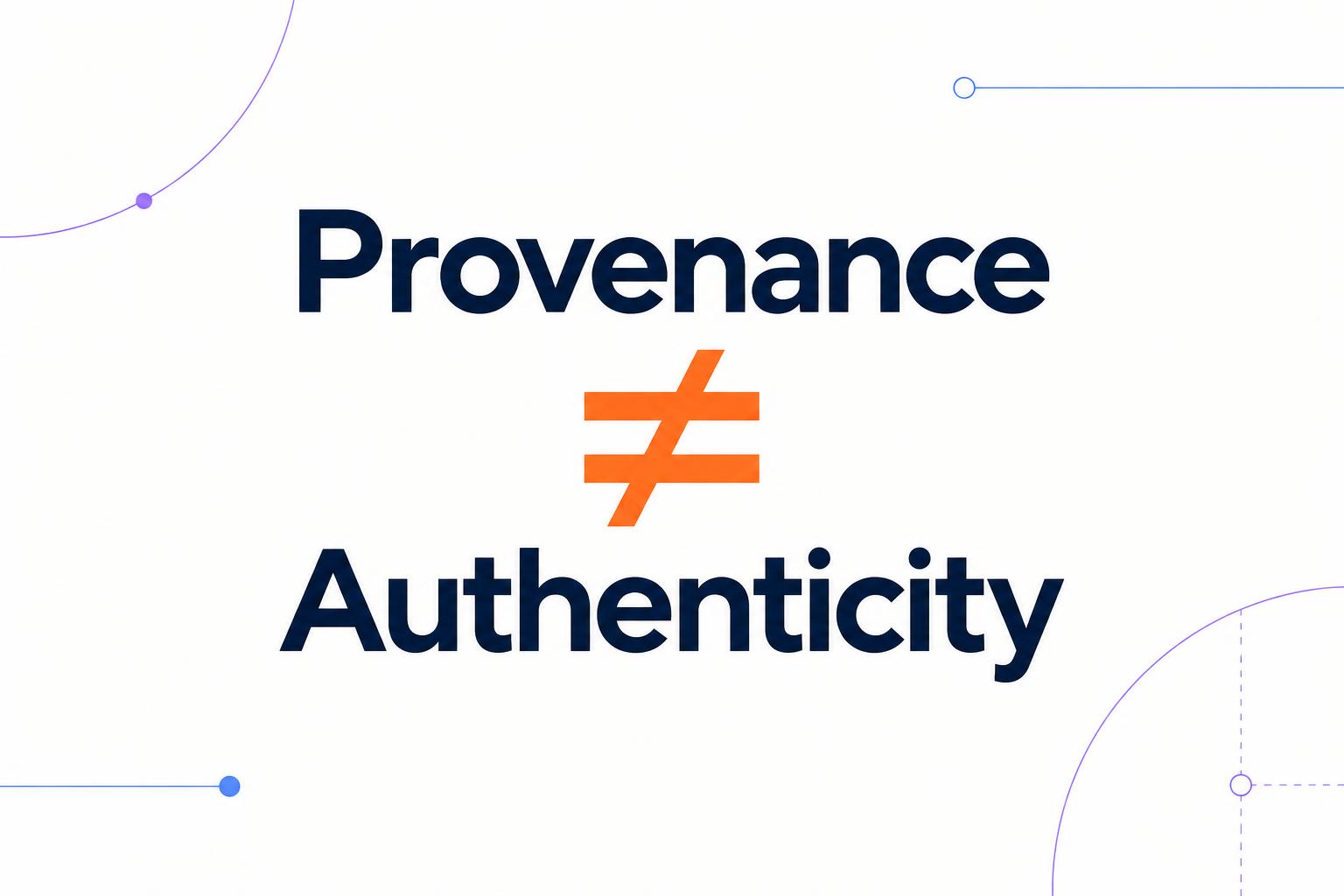
Provenance is a record. It answers: "What does this file claim about its own history?" Who made it, with what tool, when, and what was changed afterward.
Authenticity is a conclusion. It answers: "Is this genuine, and does it faithfully represent something that really happened?"
A record can be perfectly preserved and still describe something false. A signed receipt proves a store issued it, not that you got what you paid for.
Technologies like C2PA (the standard behind "Content Credentials") are excellent at provenance. They make the record tamper-evident and attributable. But they are a tool that feeds into the question of authenticity, not an answer to it.
A quick analogy: the notarised letter
Imagine you receive a letter with a notary's stamp. The stamp tells you:
- A particular notary stamped it.
- The pages haven't been swapped since.
- It happened at a certain time.
That's valuable. But the stamp doesn't tell you whether the letter's contents are honest. Someone could walk in with a lie, get it notarised, and the stamp would be completely legitimate.
Content provenance works the same way. A cryptographic signature on a photo says "this entity vouches for this exact set of bytes and this history." It doesn't say "this scene really happened."
So when someone says "this image has Content Credentials, so it's real," they've skipped a step. What they can legitimately say is "this image has a verifiable history, signed by someone I may or may not trust." Whether it's real depends on much more.
We already have AI generated content with Content Credentials. Open AI creates approximately 3B AI images a week, all signed with C2PA. This content is completely valid and correctly encoded with C2PA, they all have correct records. None of them are authentic. C2PA is showing the provenance of the AI generated content, but this cannot be confused with showing that the content is real. Provenance does not equal authenticity.
Defining the terms properly
| Question | Provenance | Authenticity |
|---|---|---|
| What is it? | A verifiable record of origin and history | A judgement that content is genuine and truthfully represents reality |
| What does it provide? | Data (cryptographic proof) | A conclusion (often probability based and contextual) |
| What question does it answer? | "Where did this content come from, and has it changed?" | "Is it real?" |
| Can software compute it alone? | Largely, yes | Yes, but not widely offered |
Provenance is a necessary ingredient for strong authenticity in a digital world. But, it is not sufficient by itself.
How C2PA works, a quick tour
C2PA is a tool, and a genuinely good one. It gives the ecosystem:
- A common, interoperable format for provenance data.
- Tamper-evidence for files and their edit histories.
- A way to label AI-generated or AI-edited content at the source.
- A foundation on which stronger authenticity systems (hardware attestation, identity frameworks, trust lists) can be built.
What it doesn't do, by design, is decide the truth. The standard is explicit that it records content data and makes it verifiable. It leaves trust decisions on whether the content is authentic to validators, platforms, and people. Just because content is signed with provenance information, doesn’t mean it is real and authentic.
Let’s get into the technical details of C2PA. Firstly, the moving parts:
A C2PA manifest is a bundle of data attached to (or linked from) a media asset. Roughly:
- Assertions
- Individual statements. For example "this was created by a camera," "these edits were applied," or "this was generated by an AI model." The standard uses vocabulary such as digitalSourceType values to distinguish captured media from algorithmically generated media.
- Claim
- A structured document that lists the assertions and includes cryptographic hashes of them.
- Claim signature
- The claim is signed (using COSE) with a private key whose X.509 certificate chains up to a trusted authority.
- Hard binding
- A hash of the asset's actual bytes (with defined exclusions for the manifest itself), so any change to the pixels breaks validation.
- Ingredients
- Hashed references to prior assets, forming a chain of edits. If you crop a photo, the new manifest can point to the original.
- Timestamps
- Optional trusted timestamps (RFC 3161-style) anchoring when the signature was made.
What validation tells you
When a validator checks a C2PA file, it can confirm things like:
- The manifest's signature is cryptographically valid.
- The signing certificate chains to a trust anchor the validator recognises.
- The asset's bytes match the hard binding.
- The history of ingredients is internally consistent.
That's a strong statement about integrity and attribution. It's still a statement about the record.
Soft bindings: recovering stripped credentials
Metadata is fragile. Screenshots, re-encoding, and many social platforms strip it. C2PA accommodates this with soft bindings, such as invisible watermarks or perceptual fingerprints, that can help look up the original manifest even after the file has been altered. This improves resilience, but it's a lookup aid, not proof. A soft-binding match is a probabilistic hint, this is materially different from a hard-bound signature.
How we are using C2PA to prove authenticity
At InReality we are helping you to answer the question: is this real?
We use C2PA, but we use it differently. Signing content with C2PA to prove not just where the content came from but crucially, if it is real. We do this by signing content cryptographically at the source, establishing authenticity at creation. Trustworthy capture and provenance tracking which survives editing and sharing online creates a complete way of guaranteeing authentic content.
InReality Capture allows content to be captured, edited and then shared with others, who can independently verify both provenance AND authenticity. Knowing where the content came from, what happened to it along the way and if it is real.
Glass to glass authenticity, from camera to viewer.
What authenticity requires
Think of authenticity as a stack. Each layer reduces uncertainty, and none of them is a magic bullet.

Trustworthy capture
Was the content created by a device whose sensors and signing keys are protected? Hardware roots of trust, secure enclaves, and attestation help here, since they let a camera prove what it is and that it hasn't been tampered with. This is the layer that speaks most directly to "was a real scene recorded."
For instance, InReality Capture signs authentic content at the source, delivering trustworthy capture on any device.
Integrity across the chain
Every edit is recorded and bound, so the path from capture to publication can be inspected. This is where C2PA shines.
InReality uses C2PA to protect integrity and track edits along the way.
Corroboration and context
Do independent sources, metadata, location, physics, and other evidence line up? OSINT verification teams do this routinely, authenticity supports this process, speeding it up.
InReality Capture provides a clear authentication record, showing exactly the data that was recorded at capture. The data is secured and easily understood by verification teams, providing an undisputable record of authenticity.
Human and institutional judgement
Ultimately someone decides whether to believe, publish, or act. Good tooling informs that decision, providing clear information about what authentication has happened and how it works. It doesn't replace human judgement entirely.
Authenticity emerges from all of these working together.
Closing thought
Provenance gives us a trail. Authenticity is the judgement we make by following it, however in the current digital world, provenance and authenticity are often conflated. If we label every signed provenance proven file as "authentic," we risk building a system that's easy to fool in exactly the way people will be most inclined to trust. If we treat provenance as a powerful input to be combined with authentic capture we get something far more useful: a world where claims about content can be checked, argued over, and trusted for good reasons.
C2PA is a very good tool. At InReality we want to use it not only for provenance but to actually prove authenticity.