Summary
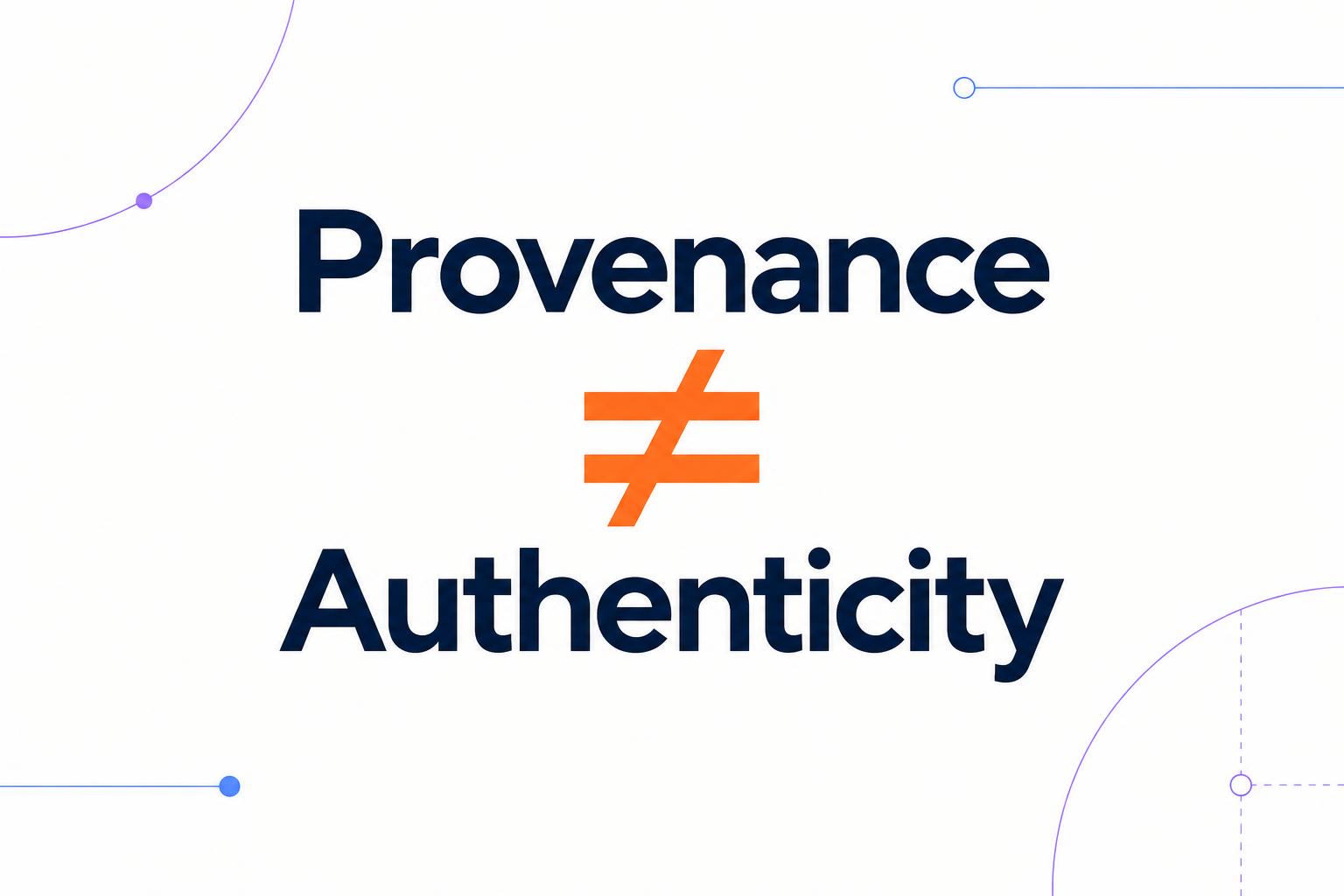
Fraud detection asks: "Does this look fake?" Authentication asks: "Is there proof this is real?"
The first question is a guess; about pixels, lighting, audio waves and statistical quirks. It gets harder every time a new generative model launches. The second is a verifiable fact established at the moment content is created, and it doesn't get weaker as AI gets better.
Detection still has a role. But as the primary defence for photos, video, audio and documents, it is struggling to keep up. The organisations that will be best protected in the next few years are the ones that stop trying to spot the fakes, but find a way of creating or receiving authentic content.
Let’s take an example: the counterfeit note
Imagine a shop that checks every banknote by eye. For years, forgeries were crude and the cashier caught most of them. Then as with many types of crime, the forgers got better and better. The shop trains staff, buys a UV pen, and catches more. Then the forgers upgrade again.
That is detection: a permanent arms race against an opponent who gets to see your defences and iterate on them.
Now imagine the central bank issues notes that carry a mark which can't be reproduced. The cashier no longer needs to judge whether a note looks right. They check whether the mark proves it's right. The forger's better printer is irrelevant.
That's the shift from detection to authentication.
Why detection is losing
Detectors work by finding traces that generative models leave behind: odd textures, lighting inconsistencies, audio artefacts. Generators are trained to remove exactly those traces, and each new model generation makes yesterday's tells disappear. A detector is always responding to the last generation of fakes. Read up on the arms race here.
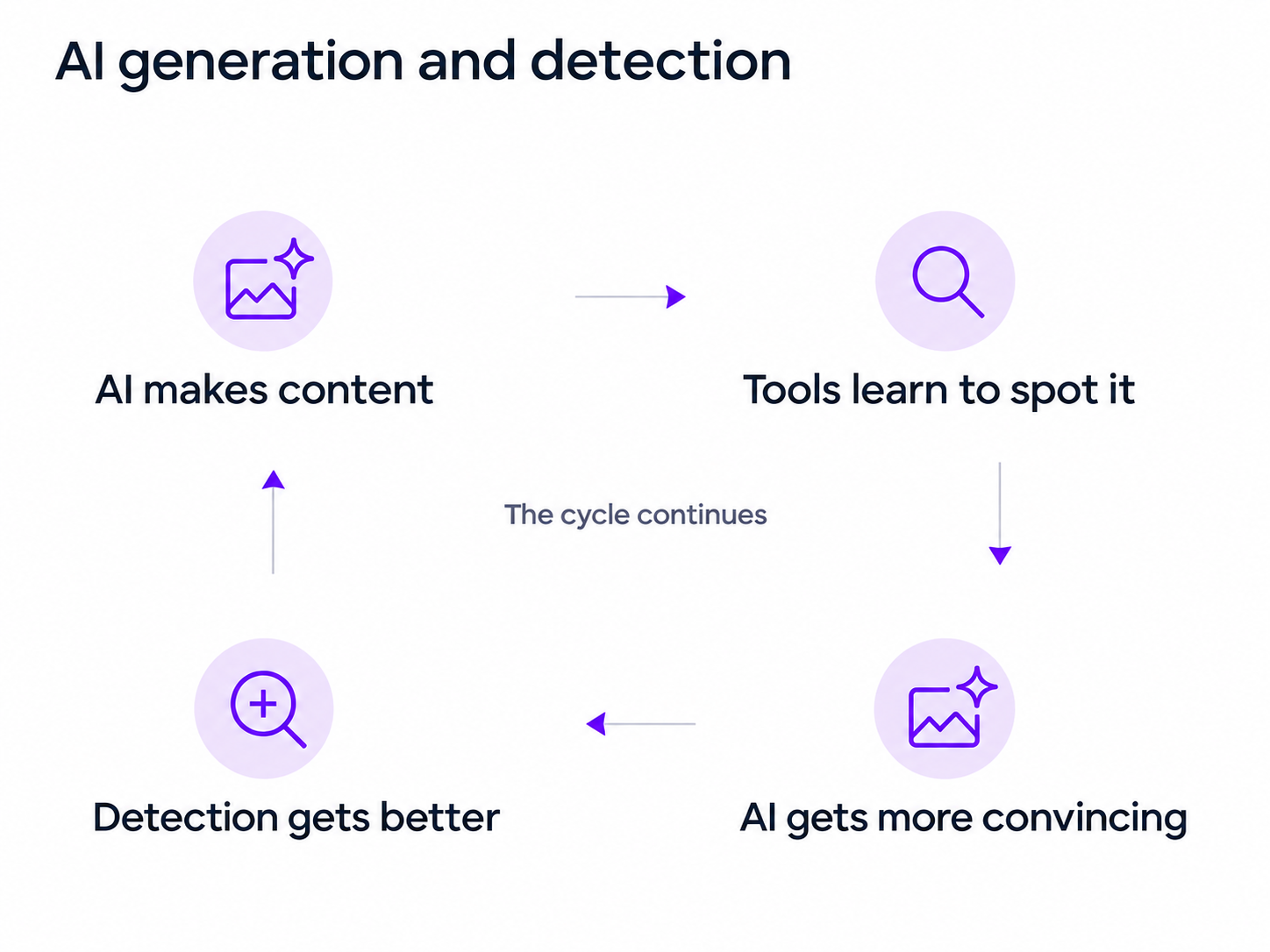
The evidence is now substantial. When researchers tested open-source deepfake detectors on real deepfakes circulated in 2024 (the Deepfake-Eval-2024 benchmark), average AUC performance fell by roughly 50% for video, 48% for audio and 45% for images compared with earlier academic benchmarks. Commercial detectors did better, but still fell short of human forensic analysts. Detectors that look excellent in the lab fall apart in the wild, because the wild keeps changing. Deloitte's own fraud lead put it plainly: tools that worked a few months ago can already be obsolete.
The stakes are rising by the day as the generation gets better and better. A Gartner 2025 survey found that 62% of organisations experienced a deepfake attack in the past year, and Deloitte projects that US fraud losses enabled by generative AI could climb from $12.3B in 2023 to $40B by 2027, a 34.3% compound annual growth rate.
There is also a second, quieter yet more underlying problem. A detector can only ever say "probably fake" or "probably real." Getting to 100% is not something it can achieve. People are being more and more tired and untrusting of online media, and as people learn that any image or recording might be synthetic, genuine content is dismissed as fake too, an effect often called the liar's dividend.
What this looks like on the ground
Live video call at Arup: the $25 million call
In early 2024, a finance employee at the engineering firm Arup's Hong Kong office joined a video call with what appeared to be the company's CFO and several colleagues. Every other participant was a deepfake. The fake was incredibly good, so much so that the employee made transfers totalling around $25 million.
Insurance: when fraudulent claims content is submitted
Claims are built on photos, scans and documents, which makes insurance an industry particularly exposed to manipulated claims evidence. Allianz UK reported a 300% rise in cases involving apps used to distort real images, video and documents in a single year. Aviva's counter-fraud head has said manipulated images and documents are "quite difficult to detect" because the detection software is itself still evolving. UK insurers have described AI-doctored vehicle photos supporting total-loss claims. Verisk's 2026 study found 98% of insurers agree AI editing tools are driving a rise in digital media fraud.
The core of the problem is that the evidence insurers depend on can no longer be trusted on sight, and the tools they rely on to check it are always a step behind. Read our look at AI content in insurance fraud here.
Identity and onboarding
The same challenge is affecting identity services. iProov reported a 2,665% rise in native virtual camera attacks, where manipulated or pre-recorded video is fed straight into verification flows, and a 300% increase in face-swap attempts year on year. Fake content is being injected into our once steadfast identity authentication systems.
The future: moving from "spot the fake" to "prove what's real"
As generated content becomes indistinguishable from authentic captured content, the question "does this look real?" stops having a reliable answer. What replaces it is a different question: "what is the verifiable history of this file, and was it created by a real capture?"
The good news is that two key developments are pushing the industry towards authentication!
Regulation is advancing the baseline and supporting technological adoption. Article 50 of the EU AI Act became enforceable on 2 August 2026, requiring machine-readable marking of AI-generated content, with penalties of up to €15 million or 3% of global turnover. California's AI Transparency Act (SB 942) became operative the same day. Neither mandates a single technology, but C2PA Content Credentials is the standard most often pointed to.
Hardware is moving, which is a fantastic support to the authentication challenge! Leica shipped the first C2PA camera in 2023. Google's Pixel 10 signs every photo by default using hardware-backed keys, Samsung's Galaxy S25 supports a similar flow albeit labelling the AI content, and Sony, Nikon and Canon have added signing to professional bodies. Platforms such as LinkedIn, TikTok and Cloudflare support or preserve credentials.
Detection vs. authentication
| Detection | Authentication | |
|---|---|---|
| Core question | "Does this look fake?" | "Can this be proven as real?" |
| Type of answer | A probability | A verifiable record |
| Works on | Retrospective: content after the fact | Proactive: content at the point of creation |
| Gets harder as AI improves? | Yes, it's a moving target | No, not affected |
| Failure mode | Misses good fakes, flags real content | Content without credentials is simply unverified |
Let’s summarise
Detection asks us to win an argument with every new model, every day, on every file. That's a contest with no finish line, and the data shows it's already tilting the wrong way, we need a new way. Authentication changes the question. Instead of asking whether a fake is good enough to fool us, we ask whether the real thing can prove itself.
The future of trust in digital content won't be built by getting better at spotting fakes. It will be built by making what's real verifiable, from the moment of capture to the moment someone relies on it.
Sources
Chandra et al., Deepfake-Eval-2024: A Multi-Modal In-the-Wild Benchmark of Deepfakes Circulated in 2024 (arXiv:2503.02857, 2025)
Gartner, Gartner Survey Reveals GenAI Attacks Are on the Rise (press release, 22 September 2025)
iProov, Study Reveals Deepfake Blindspot (February 2025); iProov Threat Intelligence Report 2025 and Gartner findings as reported by SecurityBrief (March 2026)
Deloitte Center for Financial Services, Generative AI is expected to magnify the risk of deepfakes and other fraud in banking (2024)
Verisk, State of Insurance Fraud study (March 2026), as reported by Claims Journal and PropertyCasualty360
Allianz UK, Aviva and Zurich UK commentary as reported by Insurance Times, Insurance Business and Forbes (2024–2026)
EU AI Act, Article 50; California SB 942; C2PA adoption coverage (c2paviewer.com, SoftwareSeni, Content Authenticity Initiative)
Arup deepfake incident as reported by Deloitte and iProov